How to Make a Website in 2026: A Step-by-Step Guide for Beginners
The EMI formula explained in plain English, with a worked ₹25 lakh example, tables for tenure and rate,…
5 min read

The EMI formula explained in plain English, with a worked ₹25 lakh example, tables for tenure and rate, and ways to pay less interest.
 webyfox
·
Updated November 17, 2026
·
5 min read
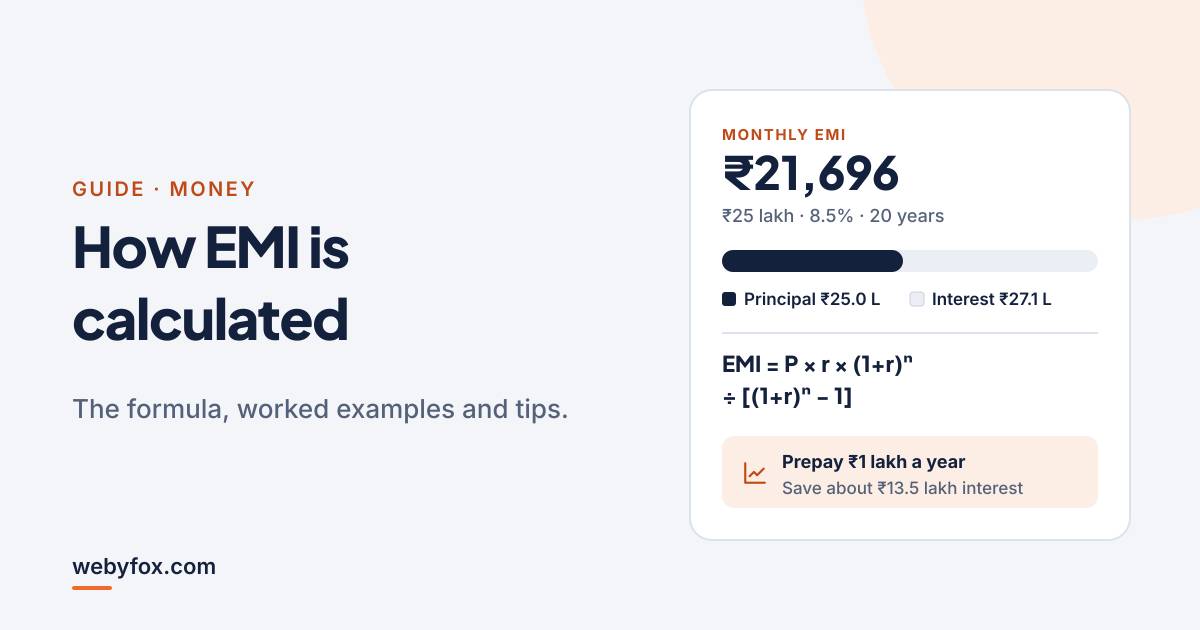
Key takeaways
Your EMI is the fixed amount you pay your bank every month until a loan is repaid. Banks show it on the loan offer, but few explain how they got there. Once you understand the formula, you can check any offer yourself and see exactly how much a lower rate, a shorter tenure or a prepayment saves you.
EMI stands for Equated Monthly Instalment. “Equated” means every instalment is the same amount. Each EMI has two parts: interest on the amount you still owe, and principal, which reduces the loan itself. At the start you owe a lot, so most of the EMI is interest. Over time the balance falls and more of each EMI goes to the principal.
EMI = P × r × (1 + r)n ÷ [(1 + r)n − 1]
In other words, on this loan you pay back more than double what you borrowed. Your bank’s figure may differ by a few rupees because of rounding or how it counts days.
Here are the first three EMIs of the same loan. Notice how small the principal part is at the start:
| EMI | You pay | Interest | Principal | Balance left |
|---|---|---|---|---|
| Month 1 | ₹21,696 | ₹17,708 | ₹3,987 | ₹24,96,013 |
| Month 2 | ₹21,696 | ₹17,680 | ₹4,015 | ₹24,91,997 |
| Month 3 | ₹21,696 | ₹17,652 | ₹4,044 | ₹24,87,953 |
On this loan, the principal part of the EMI only becomes larger than the interest part in month 143, almost 12 years in. That is why paying extra in the early years saves so much interest.
Same ₹25 lakh loan at 8.5%, with different tenures:
| Tenure | Monthly EMI | Total interest |
|---|---|---|
| 10 years | ₹30,996 | ₹12,19,571 |
| 15 years | ₹24,618 | ₹19,31,328 |
| 20 years | ₹21,696 | ₹27,06,939 |
| 25 years | ₹20,131 | ₹35,39,203 |
| 30 years | ₹19,223 | ₹44,20,221 |
Going from 20 to 30 years cuts the EMI by about ₹2,500 a month, but adds more than ₹17 lakh of interest.
Same ₹25 lakh loan for 20 years, at different rates:
| Interest rate | Monthly EMI | Total interest |
|---|---|---|
| 8% | ₹20,911 | ₹25,18,640 |
| 8.5% | ₹21,696 | ₹27,06,939 |
| 9% | ₹22,493 | ₹28,98,356 |
| 9.5% | ₹23,303 | ₹30,92,787 |
Every half a percent is worth roughly ₹800 a month and ₹1.9 lakh over the loan. It pays to compare offers.
Most home loans in India have a floating rate linked to a benchmark, so the rate can go up or down during the loan. When it changes, the bank adjusts either your EMI or your tenure.
Under RBI rules for EMI-based floating rate personal loans (which include home loans), your lender must let you choose whether to increase the EMI, extend the tenure, or a mix of both when the rate is reset. It must also tell you about any change, and let you prepay in part or in full at any time. Lenders may also offer a switch to a fixed rate under their own policy.
And for floating rate loans taken by individuals for non-business purposes, sanctioned or renewed on or after 1 January 2026, banks and NBFCs cannot charge a prepayment penalty.
Tip: If rates rise and your bank quietly extends your tenure, check your loan statement. A longer tenure keeps the EMI the same but can add years of interest. You can ask for a higher EMI instead.
EMI = P × r × (1 + r)^n ÷ [(1 + r)^n − 1], where P is the loan amount, r is the monthly interest rate (annual rate ÷ 12 ÷ 100) and n is the number of months.
About ₹21,696 a month. Over 20 years you pay about ₹52,06,939 in total, of which about ₹27,06,939 is interest.
Reducing the tenure usually saves more interest. Reduce the EMI only if you need the extra monthly cash.
It can. When the rate is reset, the lender changes the EMI, the tenure or both. Under RBI rules for EMI-based personal loans, including home loans, you get to choose.
This guide is for general information only and is not financial advice. Check exact figures and terms with your lender.
Try your own numbers in the EMI Calculator, and compare two or three tenures before you decide.


The EMI formula explained in plain English, with a worked ₹25 lakh example, tables for tenure and rate,…
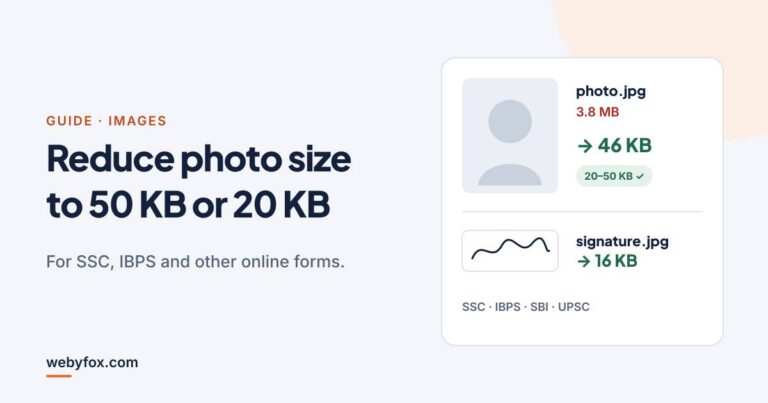
Get your photo and signature to the right size for SSC, IBPS and other online forms in four…